(c) Simply Onno GmbH
Press Release
Oct 15, 2026
Study in NEJM AI: Patients who understand their own report beforehand rate the doctor's consultation more highly
Berlin, 16. October 2026. Patients who had read their medical report in plain language before their appointment rated the consultation that followed more highly and felt more involved in decisions. The consultations were also about seven minutes shorter. These are the findings of the randomised AI-INFOCARE trial, run by the Department of Neurosurgery at the University Hospital Carl Gustav Carus Dresden and published today in the journal NEJM AI. The summaries were produced with software from the Berlin start-up Simply Onno, a cooperation partner in the study.
The important questions only come to you on the way home
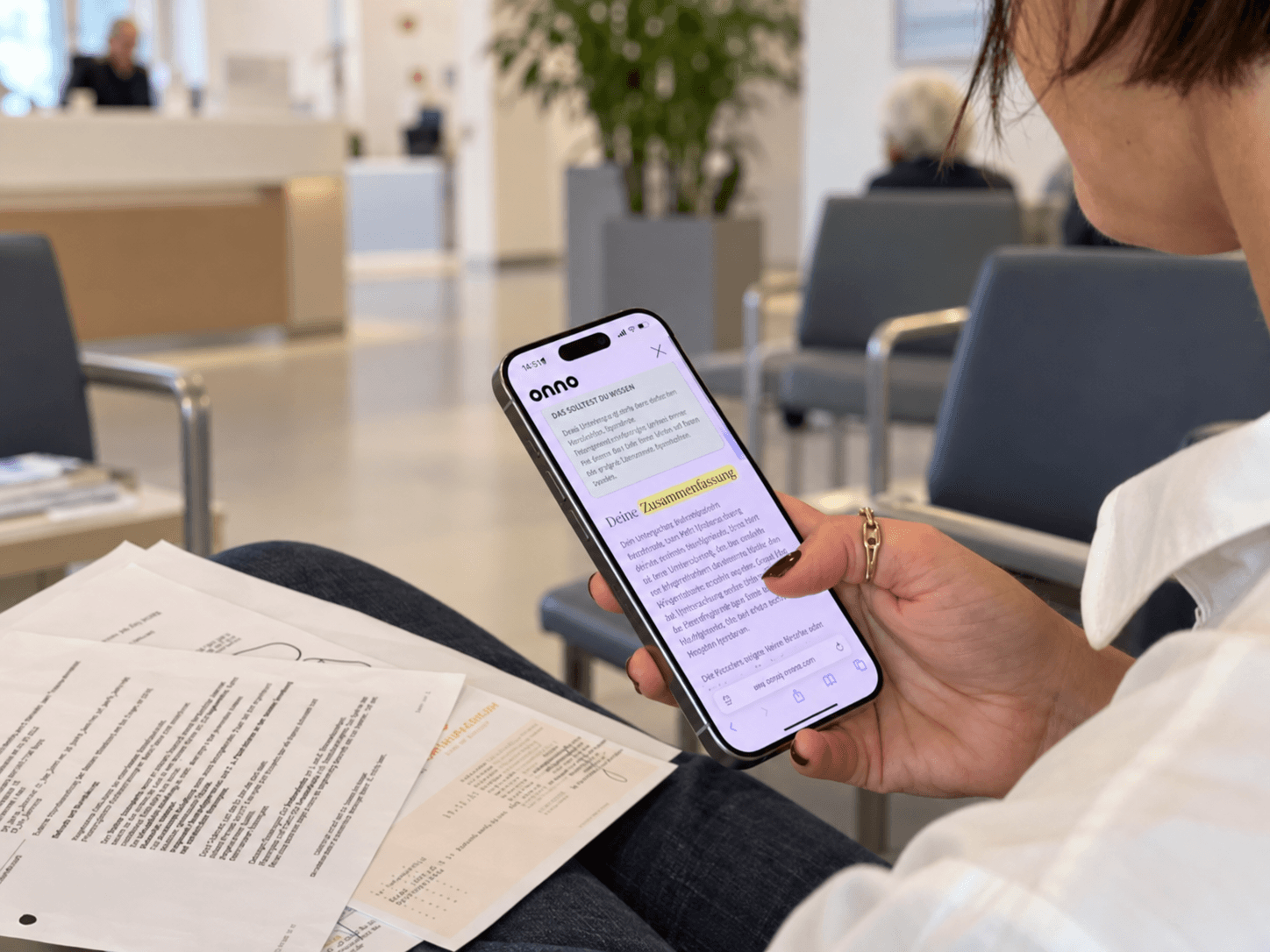
Most people who have ever received a medical report know the feeling. You sit in the appointment, get the basics explained and nod along. There's no time for the questions that really matter, or they only come to you later: on the way home, or in the evening at your laptop, once you've taken in what you first heard.
That is exactly the gap the Dresden study looks at. It examined what changes in the consultation when patients already understand their own report beforehand.
How the study was designed
Between May 2025 and January 2026, 300 patients took part. Half of them received a plain-language translation of their own documents before their first consultation at the neurosurgical outpatient clinic. The other half went into the appointment as usual. Patients were assigned to the groups at random. 17 treating physicians took part. Onno only translates the documents. It does not make diagnoses and does not replace a consultation with a doctor.
Better consultations, especially when it comes to decisions
Patients who received a translation rated their consultation significantly better (4.42 compared with 4.25 out of 5 points). The difference was largest for shared decision-making. They felt more involved in decisions about the next steps in their treatment and felt their autonomy was better supported.
One user told the Onno team why this matters so much to her: ‘It's my body, after all. It gives you something to hold on to, so you can meet the doctor as an equal. I'm supposed to give my consent to everything, but I don't even understand it.’
‘People write to us every day saying they finally understand their medical documents and can take an active part in conversations with their doctors again. It means a lot to us that this exact question has now been tested in a randomised trial,’ says Karen Hentschel, co-founder of Simply Onno.
Shorter, but not colder
There is a worry that AI could make the conversation between patients and their doctors colder. In this study, both groups rated the empathy in the consultation equally highly, even though the consultations got shorter: a median of 25 instead of 33 minutes. That is roughly a fifth less time, with a better rating.
‘I expected longer consultations, because informed patients ask more questions. It was the other way round,’ says PD Dr. med. habil. Witold Polanski, neurosurgeon at the University Hospital Dresden. ‘And they felt more involved in the decision, not less.’
Medically accurate and easy to understand at the same time
The study also tested the quality of the translations themselves. It used a frozen 2025 version of the Onno software. Each summary went through automated checks and was compared against the original document using a checklist. Two physicians also reviewed 75 randomly selected texts, each without knowing the other's assessment. Neither found a factual error, a clinically relevant omission or a potentially harmful statement. No adverse events occurred during the study.
‘We put an incredible amount of time and effort into being medically accurate without making the texts complicated. That combination is the hard part,’ says Marc Dantas Tiedemann, co-founder of Simply Onno. ‘Since day one, doctors have been proofreading our output sentence by sentence, and that will never stop. Having this standard tested in a randomised trial, with the results published in NEJM AI, is a great result for us.’
Transparency note: Alongside his work at the University Hospital, PD Dr. med. habil. Witold Polanski is a co-founder and the medical director of Simply Onno. He was not involved in the patient consultations, the data collection or the statistical analysis. The study was investigator-initiated, received no external funding and was pre-registered in the German Clinical Trials Register (DRKS00036810).
Sources
Original article: Benker-Hasani E, Richter S, Buszello C, Willkommen S, Prem M, Hijazi M, Martin KD, Juratli T, Eyüpoglu I, Polanski W. Effect of Previsit AI-Generated Document Summaries on Consultation Time and Patient-Physician Communication: The AI-INFOCARE Randomized Controlled Trial. NEJM AI 2026. doi.org/10.1056/AIoa2600136
Press release from the Faculty of Medicine Carl Gustav Carus, TU Dresden: [insert link once online]
Trial registration: DRKS00036810. Study protocol: JMIR Research Protocols 2025;14:e77204
Contact
About Simply Onno
Simply Onno is a Berlin healthtech start-up that uses AI to translate medical documents into clear, easy-to-understand language. Onno does not make diagnoses and does not replace a consultation with a doctor. A team of doctors checks the results on an ongoing basis. The company was founded in 2024 by Karen Hentschel, Marc Dantas Tiedemann, Stephan Thiel and PD Dr. Witold Polanski. Simply Onno is self-funded, ad-free and GDPR-compliant. In 2025 it won the German AI Start-up Award (Deutscher KI-Start-up-Preis) from DIE WELT.
Facts and figures
More than 100,000 medical reports translated in Germany (as of October 2026)
More than 9 out of 10 user ratings this year describe the service as ‘helpful’ or ‘very helpful’
Free summary, detailed explanation for €18.50
No registration, anonymous and ad-free